

Before buying a portable Level 2 EV charger, confirm four things: the connector approved for your exact vehicle, the electrical supply that can safely support the load, the cable route from outlet to inlet, and the controls you will use. A matching plug is only the beginning of the compatibility check.
Quick answer: Check the vehicle, power supply, reach and controls—in that order. If any one of those four does not fit your setup, pause the purchase and verify it with the vehicle documentation, charger manual or a qualified electrician.
The four checks at a glance
| Check | What to confirm | Why it matters |
|---|---|---|
| 1. Vehicle | Exact model year, AC charging inlet and any approved adapter | A connector that appears to fit does not prove the complete setup is approved. |
| 2. Power | Outlet type, circuit capacity, wiring condition and local requirements | Level 2 equipment draws a continuous electrical load and must match the available supply. |
| 3. Reach | Real route from the outlet to the parked vehicle inlet | A cable must reach without crossing a driving path, being stretched or creating a trip hazard. |
| 4. Controls | Current settings, scheduling and status information you will actually use | Useful controls help a charger fit a daily routine, but they do not replace electrical or vehicle checks. |

1. Start with the vehicle—not the charger listing
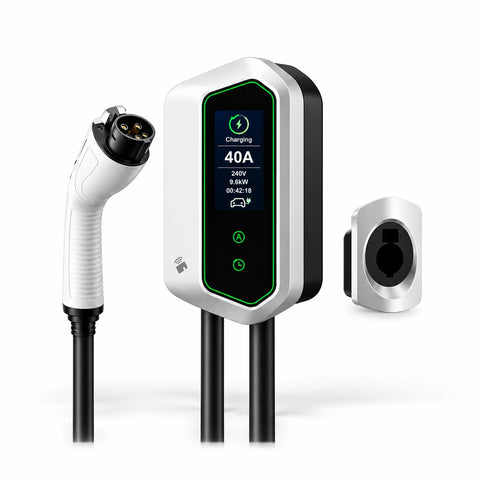
Identify the charging inlet on your exact vehicle and model year. In North America, two names you will see often are NACS and J1772. They are different connector systems. A product described as a NACS charger should only be considered for a vehicle and charging configuration that the manufacturer documentation permits.
Do not rely on the vehicle brand alone. Connector arrangements can differ by model year, market and adapter policy. Check the owner’s manual or the manufacturer’s official charging guidance. If an adapter is involved, verify that the vehicle maker and charging-equipment maker both permit the proposed combination.
Also keep AC home charging separate from DC fast charging. A portable Level 2 product is AC charging equipment. A familiar connector shape does not turn it into a Supercharger or another DC fast-charging product.
Vehicle questions to answer
- What is the exact vehicle model and model year?
- Which AC inlet or approved adapter does its documentation specify?
- Does the vehicle documentation state a maximum AC charging rate?
- Are there storage, temperature or outdoor-use instructions you need to follow?
2. Confirm the 240-volt supply and circuit
Level 2 charging commonly uses a 240-volt supply. The U.S. Department of Energy notes that a qualified electrician can determine whether a home has enough electrical capacity and can add an appropriate circuit where needed. Local permits and code requirements may also apply.
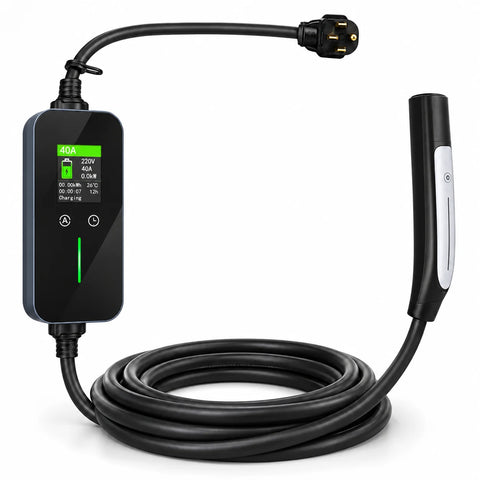
If a portable charger lists a NEMA 14-50 input, that tells you the plug configuration. It does not, by itself, confirm the outlet, wiring, breaker, panel capacity or installation quality. An existing receptacle may have been installed for another purpose or may not be suitable for the intended continuous load.
Ask a qualified electrician to assess the complete path: service capacity, panel, breaker, conductor size, receptacle, enclosure and installation location. Use the charger’s final manual and nameplate information when discussing the load. Avoid choosing a charging current first and trying to make the electrical system fit afterward.
Electrical questions to answer
- Is the receptacle type the one listed for the charger?
- Is the branch circuit dedicated and sized for the intended continuous load?
- Is the receptacle, wiring and enclosure in good condition?
- Is the location suitable for the equipment’s documented environmental rating?
- Does the project require a permit or inspection in your area?
3. Measure the real parking route
Cable length should be measured along the route the cable will actually follow, from the outlet to the vehicle inlet in the normal parking position. Include changes in height, bends around fixed objects and the inlet location on the vehicle. Leave enough slack for a practical connection without pulling on the plug or control unit.
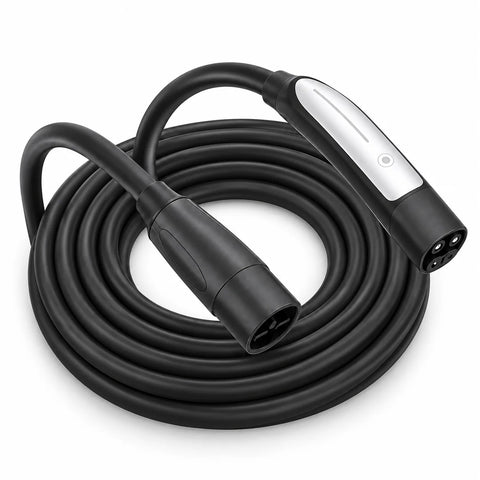
The shortest practical route is usually easier to manage. Keep the cable away from tires, doors, sharp edges, standing water and busy walkways. Do not plan around a cable being tightly stretched. If the supplied cable does not reach safely, review the outlet location, parking position or installation plan before adding any accessory. An extension should only be considered when the equipment manufacturer explicitly permits it and all ratings are verified.
4. Choose controls that fit your routine
After vehicle, electrical and reach checks are complete, compare the controls. Adjustable current can help match a charger to an approved electrical setup. A delay timer can help align charging with a planned schedule. A clear display can make status easier to review.
These features do not create additional electrical capacity and do not guarantee a fixed charging speed. Actual charging power is limited by the circuit, the charging equipment and the vehicle. Battery state, temperature and vehicle settings can also affect a charging session.
How EV0001 fits this checklist
The current VOLGOO EV0001 product page presents it as a portable 240-volt Level 2 option for compatible NACS vehicles. Listed details include a NEMA 14-50 input, adjustable 16A–40A current settings, a 25-foot cable and a 1–12 hour delay setting.
Treat those features as inputs to your compatibility review. Before ordering, compare the final product documentation with your exact vehicle and electrical setup. If a specification or document is essential to the purchase, contact support@volgoo.com before ordering. Specifications and documentation can be revised, so the current product page and model instructions should control.
A practical ten-minute buying check
- Write down the vehicle model and model year.
- Confirm the approved AC connector or adapter in the vehicle documentation.
- Photograph the outlet and note its location, without opening electrical equipment.
- Ask an electrician to verify the intended circuit and receptacle when suitability is uncertain.
- Measure the cable route with the vehicle parked normally.
- Check which current and scheduling controls you will use.
- Read the current charger manual and product page before placing the order.
Frequently asked questions
Is every NACS portable charger compatible with every NACS vehicle?
No. The connector is one part of compatibility. Confirm the exact vehicle model, model year, approved charging equipment or adapter, AC charging limits and the charger documentation.
Does a NEMA 14-50 outlet mean I can use a 40-amp setting?
Not automatically. Outlet shape alone does not establish circuit suitability. A qualified electrician should assess the service, circuit, breaker, conductors, receptacle and installation against the equipment instructions and local requirements.
How fast will a portable Level 2 charger charge my vehicle?
There is no single answer for every vehicle or home. Actual power is limited by the electrical supply, charger and vehicle. Battery state, temperature and vehicle settings also matter. Use the lowest verified limit in the complete setup.
Can I add an extension if the 25-foot cable does not reach?
Only consider an extension when the charging-equipment manufacturer explicitly permits it and the complete ratings and use conditions are verified. Otherwise, review the outlet location, installation plan or parking arrangement.
Sources and next step
- U.S. Department of Energy Alternative Fuels Data Center: Charging Electric Vehicles at Home
- VOLGOO EV0001 product details
- VOLGOO product manuals and documentation
Reviewed October 13, 2026. This guide is educational and does not replace the product manual, vehicle documentation, local electrical requirements or advice from a qualified electrician.